91ºÚÁÏÍø

Articles
5/22/2023
10 minutes

Software Bugs: The Three Causes of Programming Errors

Written by
Esko Hannula
Table of contents

“Bug†is a common word among software professionals. Also known as defects, a bug simply means the software isn’t behaving as expected. The word bug is used quite liberally to refer to both the symptom and the cause. 

In proper terms, a bug is really a human error that produces a defect that causes a fault in the operation of the software, resulting in a malfunction that causes some sort of damage. Unfortunately, most software defects cause damages that are far worse: loss of time and nerve.

Sometimes, the same sequence of actions can result in a malfunction for one user but not the other. Software folks often call these “random bugsâ€. In reality, there are no random bugs. The effect (the occurrence of the fault) may be random, but the cause (the error in the code) is always there: the malfunction is happening for a reason.

To Err Is Human

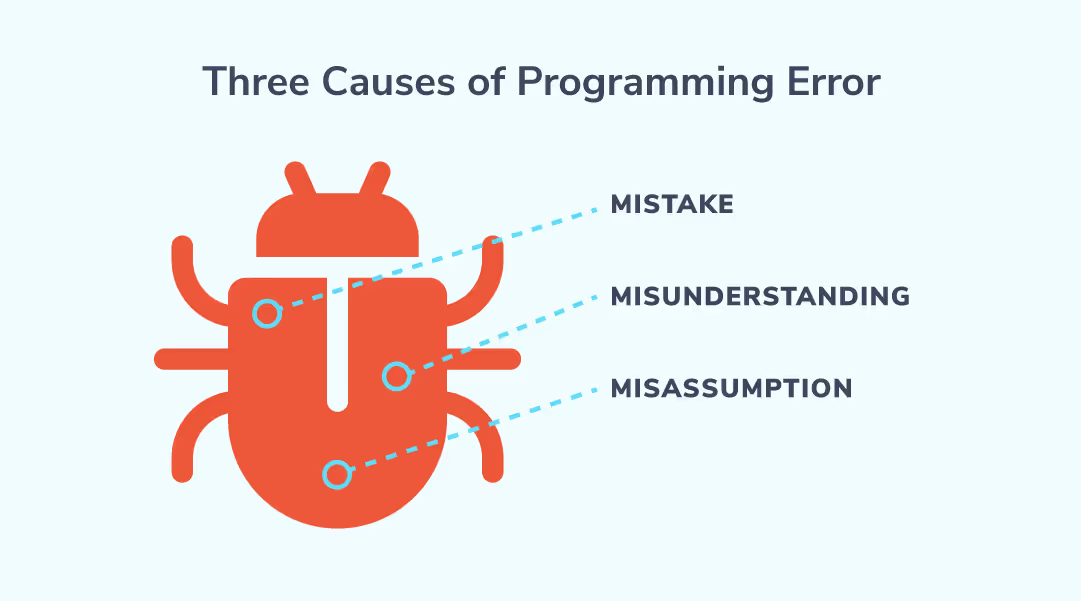
The cause of a programming error is usually one of the three “missesâ€:

Mistakes Lead to Massive Malfunctions

Developers often face unrealistic deadlines to deliver new functionality, make enhancements or deploy fixes. Under these conditions, it’s easy to imagine how software developers make mistakes. They hit the wrong letter, confuse one variable with another, accidentally use “greater than†instead of “less than†or place an index value off by one. A tiny typing error may, indeed, be the root cause of a massive malfunction.

Misunderstanding Is a More Complex Form of Human Error

The developer makes the code behave exactly as they wanted; with no mistakes. Instead, the developer misunderstands how the software should behave. We have all done it: read instructions, believe you do exactly as instructed, just to realize later that you misunderstood the instruction.

Software developers’ instructions are known as “requirementsâ€. Requirements are plain English descriptions of how the software should behave. Such misunderstandings tend to get expensive. They are typically found in the later testing stages and testers often fail to spot them, too.

Oftentimes, the error is surprisingly in the requirement itself. It is not uncommon for a developer to implement a requirement exactly as it was described and find out later that the software does not behave as the real users would have expected. This is still an error but not a programming error.

Misassumption Is the Most Challenging Form of Error

As Einstein would say, “Assumptions are made and most assumptions are wrong.†But software developers need to make plenty of assumptions.

They assume that their programming tools and underlying operating systems are free of errors. They assume the utility libraries they use behave in a certain way. They assume the other system their code is interfacing with always responds appropriately. They assume the response from that other system is never longer than 1024 bytes. And so on. You can never be prepared for everything.

Those dependencies do not, however, remain constant. The underlying operating system gets a version update or the developer next door releases a new version of their library. The URL of the web API changes. The beauty of misassumptions is that a developer’s correct code may begin malfunctioning even though the developer did not touch it at all.

The Criticality of Finding Bugs

A software tester's job is to find the bugs in a controlled environment before the software is deployed to real users. And with strict timelines, there’s never enough time to test thoroughly. Besides that, testers are human beings, too, and may make errors. At best, manual testing can reduce the probability of malfunction in production but never fully eliminate all the bugs.

If testers don’t find many bugs, it may mean several things:

  • the software was poorly tested: the bugs are there, but we just don’t know it yet
  • the developers have done a great job testing their code so that there’s little left for the tester to find
  • customers will find the bugs and then complain

The golden rule is to never confuse the absence of proofs with the proof of absence. Just because you didn’t find a bug does not fully disprove that a bug can exist. With such uncertainty, how can you optimize the testing process to maximize the number of bugs you find?

To start, you need to remove as much human error as possible. That’s where test automation comes in. Combined with continuous delivery, automated testing will enable your team to test more thoroughly and earlier in the process. Test automation enables you to catch bugs at the source rather than later down the pipeline when it’s more difficult and more costly to correct.

With pressure to deliver every functionality faster, time is of the essence for developers, which, unfortunately, is a scarce resource they never seem to have enough of. Leveraging test automation alongside your developer workflows will boost productivity without the worry of introducing more or missing bugs early in the dev process.

If you’re looking to provide some sanity to your dev team and want to empower them with a DevOps solution that improves speed and quality, visit copado.com/robotic-testing for a demo.

About the Author

Esko Hannula is an experienced software executive with a life-long interest in the connection between software quality and business performance. He’s known for insightful and often provocative ideas. Prior to joining 91ºÚÁÏÍø, Esko has collected 30+ years of leadership experience in software, IT, telecom, and services industries.

Book a demo

About The Author

SVP, Product Management

Esko Hannula is an experienced software executive with a life-long interest in the connection between software quality and business performance. He’s known for insightful and often provocative ideas. Prior to joining 91ºÚÁÏÍø, Esko has collected 30+ years of leadership experience in software, IT, telecom, and services industries.

91ºÚÁÏÍø Introduces ´¡²µ±ð²Ô³Ù¾±²¹â„¢, Bringing Context-Aware AI Agents to Salesforce DevOps
DevOps Pipeline Best Practices
DevSecOps vs. DevOps
DevOps vs. Agile
Generative AI in DevOps
How DevOps Teams Use AI to Win
Using AI in DevOps
Agentic AI in DevOps: Automation Solutions for Teams
91ºÚÁÏÍø Awarded on CarahSoft’s GSA Schedule, Expanding Access for Federal Agencies
Salesforce Agentforce AI Capabilities and Solutions
Salesforce AI Agent Software Features for DevOps Teams
91ºÚÁÏÍø Renews FedRAMP Authorization and Advances Toward IL5 to Support U.S. Military Organizations
91ºÚÁÏÍø Appoints Rajit Joseph as Chief Product Officer to Accelerate AI-Driven Customer Success and Product Innovation
91ºÚÁÏÍø Recognized in Salesforce 2025 Partner Innovation Awards
91ºÚÁÏÍø Appoints Gaurav Kheterpal as Chief Evangelist to Accelerate Global DevOps Community Growth
91ºÚÁÏÍø CI/CD & Robotic Testing Now TX-RAMP Certified for Texas Government
Org Intelligence: Why Context Matters So Much in Salesforce DevOps Tools
Hubbl Technologies and 91ºÚÁÏÍø Forge Strategic Alliance to Power AI-Driven DevOps with Deep SaaS Context
From Chaos to Control: Why Public Sector Teams Are Moving Beyond Manual Pipelines
91ºÚÁÏÍø Hosts India's Flagship DevOps Conference in Response to Overwhelming Demand
What Does “Org Intelligence†Really Mean for Salesforce Teams?
91ºÚÁÏÍø Launches Org Intelligence to Provide End-to-End Visibility into Salesforce Environments
Why Pipeline Visibility Is Key to Successful Salesforce DevOps Transformation
91ºÚÁÏÍø Robotic Testing Now in AWS Marketplace, AI-Powered Salesforce Test Automation at Scale
Navigating User Acceptance Testing on Salesforce: Challenges, Best Practices and Strategy
Navigating Salesforce Data Cloud: DevOps Challenges and Solutions for Salesforce Developers
Chapter 8: Salesforce Testing Strategy
Beyond the Agentforce Testing Center
How to Deploy Agentforce: A Step-by-Step Guide
How AI Agents Are Transforming Salesforce Revenue Cloud
The Hidden Costs of Building Your Own Salesforce DevOps Solution
Chapter 7 - Talk (Test) Data to Me
91ºÚÁÏÍø Announces DevOps Automation Agent on Salesforce AgentExchange
Deploying CPQ and Revenue Cloud: A DevOps Approach
91ºÚÁÏÍø Launches AI-Powered DevOps Agents on Slack Marketplace
Redefining the Future of DevOps: Salesforce’s Pioneering Ideas and Innovations
91ºÚÁÏÍø Announces DevOps Support for Salesforce Data Cloud, Accelerating AI-Powered Agent Development
AI-Powered Releasing for Salesforce DevOps
Top 3 Pain Points in DevOps — And How 91ºÚÁÏÍø AI Platform Solves Them
91ºÚÁÏÍø AI Platform: A New Era of Salesforce DevOps
91ºÚÁÏÍø Expands Its Operations in Japan with SunBridge Partners
Chapter 6: Test Case Design
Article: Making DevOps Easier and Faster with AI
Chapter 5: Automated Testing
Reimagining Salesforce Development with 91ºÚÁÏÍø's AI-Powered Platform
Planning User Acceptance Testing (UAT): Tips and Tricks for a Smooth and Enjoyable UAT
What is DevOps for Business Applications
Testing End-to-End Salesforce Flows: Web and Mobile Applications
91ºÚÁÏÍø Integrates Powerful AI Solutions into Its Community as It Surpasses the 100,000 Member Milestone
How to get non-technical users onboard with Salesforce UAT testing
DevOps Excellence within Salesforce Ecosystem
Best Practices for AI in Salesforce Testing
6 testing metrics that’ll speed up your Salesforce release velocity (and how to track them)
Chapter 4: Manual Testing Overview
AI Driven Testing for Salesforce
Chapter 3: Testing Fun-damentals
AI-powered Planning for Salesforce Development
Salesforce Deployment: Avoid Common Pitfalls with AI-Powered Release Management
Exploring DevOps for Different Types of Salesforce Clouds
91ºÚÁÏÍø Launches Suite of AI Agents to Transform Business Application Delivery
What’s Special About Testing Salesforce? - Chapter 2
Why Test Salesforce? - Chapter 1
Continuous Integration for Salesforce Development
Comparing Top AI Testing Tools for Salesforce
Avoid Deployment Conflicts with 91ºÚÁÏ꿉۪s Selective Commit Feature: A New Way to Handle Overlapping Changes
Enhancing Salesforce Security with AppOmni and 91ºÚÁÏÍø Integration: Insights, Uses and Best Practices
From Learner to Leader: Journey to 91ºÚÁÏÍø Champion of the Year
The Future of Salesforce DevOps: Leveraging AI for Efficient Conflict Management
A Guide to Using AI for Salesforce Development Issues
How to Sync Salesforce Environments with Back Promotions
91ºÚÁÏÍø and Wipro Team Up to Transform Salesforce DevOps
DevOps Needs for Operations in China: Salesforce on Alibaba Cloud
What is Salesforce Deployment Automation? How to Use Salesforce Automation Tools
Maximizing 91ºÚÁÏÍø's Cooperation with Essential Salesforce Instruments
From Chaos to Clarity: Managing Salesforce Environment Merges and Consolidations
Future Trends in Salesforce DevOps: What Architects Need to Know
Enhancing Customer Service with 91ºÚÁÏÍøGPT Technology
What is Efficient Low Code Deployment?
91ºÚÁÏÍø Launches Test Copilot to Deliver AI-powered Rapid Test Creation
Cloud-Native Testing Automation: A Comprehensive Guide
A Guide to Effective Change Management in Salesforce for DevOps Teams
Building a Scalable Governance Framework for Sustainable Value
91ºÚÁÏÍø Launches 91ºÚÁÏÍø Explorer to Simplify and Streamline Testing on Salesforce
Exploring Top Cloud Automation Testing Tools
Master Salesforce DevOps with 91ºÚÁÏÍø Robotic Testing
Exploratory Testing vs. Automated Testing: Finding the Right Balance
A Guide to Salesforce Source Control | 91ºÚÁÏÍø
A Guide to DevOps Branching Strategies
Family Time vs. Mobile App Release Days: Can Test Automation Help Us Have Both?
How to Resolve Salesforce Merge Conflicts: A Guide
91ºÚÁÏÍø Expands Beta Access to 91ºÚÁÏÍøGPT for All Customers, Revolutionizing SaaS DevOps with AI
Is Mobile Test Automation Unnecessarily Hard? A Guide to Simplify Mobile Test Automation
From Silos to Streamlined Development: Tarun’s Tale of DevOps Success
Simplified Scaling: 10 Ways to Grow Your Salesforce Development Practice
What is Salesforce Incident Management?
What Is Automated Salesforce Testing? Choosing the Right Automation Tool for Salesforce
91ºÚÁÏÍø Appoints Seasoned Sales Executive Bob Grewal to Chief Revenue Officer
Business Benefits of DevOps: A Guide
91ºÚÁÏÍø Brings Generative AI to Its DevOps Platform to Improve Software Development for Enterprise SaaS
91ºÚÁÏÍø Celebrates 10 Years of DevOps for Enterprise SaaS Solutions
Go back to resources
There is no previous posts
Go back to resources
There is no next posts

Explore more about

End-to-End Testing
Articles
April 14, 2026
91ºÚÁÏÍø Introduces ´¡²µ±ð²Ô³Ù¾±²¹â„¢, Bringing Context-Aware AI Agents to Salesforce DevOps
Articles
March 4, 2026
DevOps Pipeline Best Practices
Articles
February 25, 2026
DevSecOps vs. DevOps
Articles
February 23, 2026
DevOps vs. Agile

Activate AI — Accelerate DevOps

Release Faster, Eliminate Risk, and Enjoy Your Work.
Try 91ºÚÁÏÍø Devops.

Resources

Explore our DevOps resource library. Level up your Salesforce DevOps skills today.

Upcoming Events & Webinars

E-Books and Whitepapers

Support and Documentation

Demo Library